Have you ever looked at a tiny object and wondered, “How big is that actually?” A number like 3mm can feel almost imaginary because we usually think in centimeters, inches, or even feet. A millimeter (mm) is such a small unit that it often disappears from our everyday conversations, yet it quietly shapes the world around us. From the tiny screw holding a watch together to the bead used in a handmade bracelet, these small measurements are everywhere.
When someone asks What does 3mm look like, they are usually not asking for a mathematical answer alone. They want a picture in their mind. They want a familiar object they can hold and say, “Oh, that’s about that size.” This kind of visual size comparison makes a tiny measurement suddenly feel real.
A 3mm measurement equals 0.3 centimeters, 0.003 meters, and about 0.118 inches. In terms of measurement conversion, it is also roughly 0.01 feet, which sounds strange because feet are used for much larger objects. A tiny number like this reminds us that the world is built with many layers of size, from giant buildings to microscopic components.
This guide explores 9 common things that are 3mm big and explains how to recognize them without always grabbing a ruler. Some objects are around 3mm in diameter, while others are close because of their thickness or width. Tiny differences do matter, but these examples give a practical sense of scale. Tiny things can be surprisingly interesting, honestly.
| Object | Approximate 3mm Comparison |
|---|---|
| Black peppercorn | Around 3mm diameter |
| Small jewelry bead | Common 3mm bead size used in crafts |
| Seed bead | Tiny bead used for necklaces and bracelets |
| Thick pencil tip | Similar to a 3mm width when unsharpened |
| Tiny screw | Some electronics screws have around 3mm diameter |
| Watch screw head | Small precision part close to this size |
| Earbud cable | Some cable thicknesses are near 3mm |
| Coarse salt crystal | Larger crystals can reach about 3mm |
| Thin plastic sheet | Some craft plastic materials have 3mm thickness |
Understanding How Big Is 3mm Before Looking at Examples

Before exploring 3mm examples, it helps to understand the actual dimensions. The word “millimeter” comes from the metric system, where small measurements are divided into very precise units. A ruler marked with millimeters shows that ten millimeters make one centimeter, so 3mm in cm is simply less than half a centimeter.
A 3mm size comparison is easiest when you imagine something familiar. It is not as tiny as a grain of dust, but it is much smaller than a coin. It is about the width of some small beads, the thickness of certain materials, or the diameter of small hardware pieces.
People often ask how small is 3mm because numbers alone do not create an image. Here are a few ways to estimate it:
- A little less than the thickness of many credit cards stacked in a single measurement comparison.
- Around the size of a small decorative bead used in crafts.
- Close to the diameter of a small peppercorn.
- Similar to the width of some tiny screws used in electronics.
- About the size of a thick pencil tip.
When trying to estimate size without ruler, your eyes become the measurement tool. It is not perfect precision measurement, but it works well for everyday situations. We naturally compare unknown objects with known objects all the time.
3mm Size Comparison: A Black Peppercorn Gives a Simple Visual Example
One of the easiest real-life examples of 3mm is a small black peppercorn. Not every peppercorn is exactly the same, because nature doesn’t manufacture things with a factory ruler, but many smaller peppercorns sit close to the 3mm diameter range.
A peppercorn is a great size reference object because most people have seen one sitting on a kitchen counter. When someone asks what does 3mm look like in real life, imagining a tiny round peppercorn is often enough to create the right picture.
The peppercorn diameter can vary depending on the type and how it grows. Still, it gives a useful comparison for understanding 3mm objects.
- A black peppercorn can help visualize a small round measurement.
- It shows what a 3mm diameter example looks like without technical equipment.
- It makes a tiny metric measurement easier for children and adults to understand.
- It provides a common household item for size comparison.
- It helps explain why millimeters are used for small items.
A grandmother once explained tiny measurements by saying, “Small things don’t need big words; they need something your hands already know.” That idea is actually pretty smart. A familiar object can teach measurement better than a complicated chart.
3mm Bead Size and the Tiny World of Jewelry Crafts
Craft lovers often encounter 3mm bead size measurements when creating necklaces, bracelets, earrings, and handmade accessories. A bead seller may describe tiny beads using millimeters because even a small change can completely alter a jewelry design.
A small jewelry bead measuring around 3mm is delicate and lightweight. It is commonly used as a supporting piece rather than the main attraction. In detailed designs, many tiny beads are combined together to create patterns, colors, and textures.
These beads are popular among people who enjoy DIY projects and decorative designs. The world of craft supplies depends heavily on accurate sizing because a bracelet made with 3mm beads feels very different from one made with larger pieces.
Examples of where these small beads appear include:
- Seed bead jewelry used for detailed patterns.
- Handmade necklaces with tiny decorative sections.
- Bracelets that need lightweight materials.
- Earrings where a small accent piece creates balance.
- Craft materials for miniature artwork.
- Decorative designs requiring careful bead sizing.
- DIY projects where every small measurement changes the final look.
The beauty of tiny craft materials is that the smallest pieces can carry the biggest creative ideas. A bead only a few millimeters wide can become part of a meaningful gift, a cultural design, or a personal memory.
3mm Screw Size: Tiny Hardware Holding Big Things Together
It is funny how something so small can do such an important job. A 3mm screw size is common in many areas involving electronics and small hardware parts. These screws may not look impressive, but they help hold together devices people use every day.
Electronics manufacturers often rely on precise specifications because a screw that is slightly too large or too small may not fit correctly. A watch screw head, laptop screw, phone screw, or glasses screw can involve incredibly careful engineering.
When people search for a 3mm screw size explanation, they are usually trying to identify replacement hardware or understand repair tools. The measurement may refer to the diameter of the screw, not always the entire length.
Small screws around this range are connected with:
- Electronics components.
- Laptop repairs.
- Phone repairs.
- Glasses hardware.
- Watch parts.
- Precision screwdriver tools.
- Replacement hardware kits.
A repair technician once joked that tiny screws have a talent for disappearing exactly when you need them most. That little frustration is very real. These small parts require patience, good lighting, and sometimes a bit of luck.
A Pencil Tip: A 3mm Example from the World of Drawing and Art
Artists understand small measurements because tiny changes create different results. A thick pencil tip may appear close to 3mm, especially before sharpening or when using certain drawing tools.
The size of a pencil tip influences line thickness, shading, and sketching style. A broader graphite area creates darker marks, while a fine point allows detailed work.
For students learning drawing, a pencil provides an easy visual measurement guide. They may not carry a ruler everywhere, but they know what a pencil looks like.
A pencil-related 3mm comparison includes:
- Drawing pencils with thicker graphite tips.
- Sketch pencils used for shading.
- Graphite points after repeated use.
- Artistic design tools requiring controlled pressure.
- Creative materials used in classrooms.
A tiny measurement can completely change an artist’s approach. Sometimes the smallest edge of graphite creates the strongest visual effect.
Other Everyday Objects That Are Approximately 3 Millimeters
The world is full of small objects around 3mm that we ignore because they are normal parts of life. Once you start noticing measurements, ordinary objects become fascinating.
Here are more examples that can help with 3mm visual example comparisons:
- Earbud cable: Some earbud wires have a cable thickness close to a few millimeters depending on the protective covering.
- Charging cable: The outer width of some slim charging cables can approach this size.
- Coarse salt crystal: Larger salt crystals may reach around a few millimeters, though many are much smaller.
- Thin plastic sheet: Certain plastic materials used for packaging, crafts, or protective covers may have around 3mm thickness.
- Watch parts: Precision watch components often involve tiny dimensions similar to this range.
- Small craft supplies: Decorative pieces frequently use millimeter measurements for consistency.
- Protective covers: Lightweight materials can be measured by their thickness rather than their overall size.
These examples show why physical dimensions matter. Manufacturers, artists, engineers, and hobbyists all depend on accurate measurements.
How to Visualize 3mm Without a Ruler
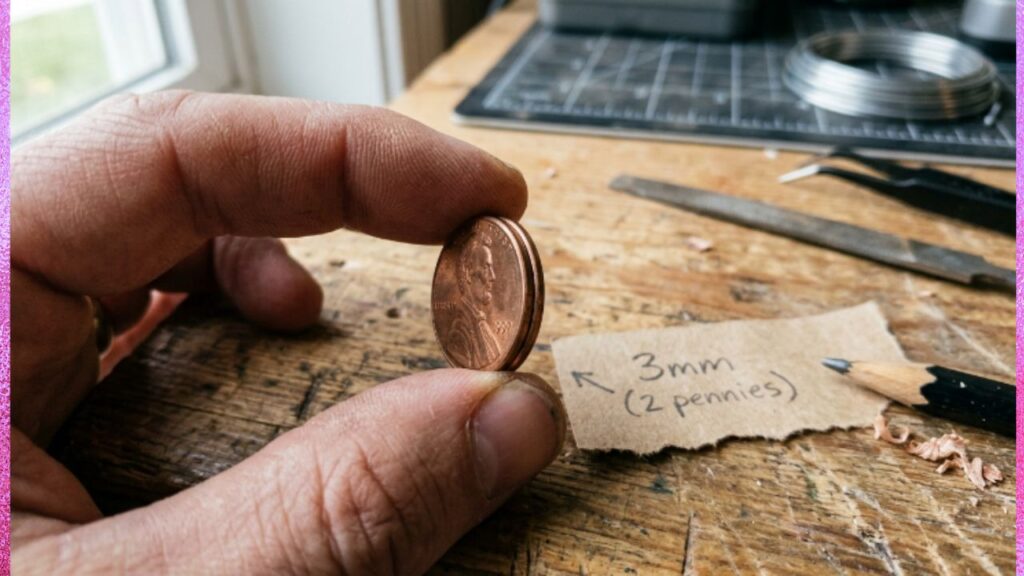
Many people want to know how to visualize 3mm without a ruler. The answer is simple: compare it with objects you already know. Your goal is not laboratory accuracy but a useful estimate.
Try these techniques:
- Use a credit card thickness comparison as a rough reference.
- Compare the object with your fingernail width.
- Place it beside a pencil tip.
- Use common household items as size references.
- Remember that three millimeters is less than half a centimeter.
Your finger can also help, although everyone’s hands are different. A visual measurement is always an approximation. For exact work, a ruler, caliper, or measuring tool is still needed.
This is why measurement comparison is valuable. It connects abstract numbers to real experiences. Numbers become less confusing when they have a story attached.
Why Tiny Measurements Like 3mm Matter in Everyday Life
It may seem strange to care about such a tiny number, but small measurements control many things around us. A tiny difference in width, thickness, or diameter can affect whether a product works properly.
In engineering, jewelry making, electronics, and design, a few millimeters can separate success from failure. Precision parts need careful planning because tiny mistakes can create big problems.
Understanding 3mm thickness examples and 3mm diameter examples helps people make better choices when buying products, repairing devices, or creating handmade items.
A tiny measurement is not really tiny when it affects something important.
Frequently Asked Questions About 3mm Measurements
How big is 3mm compared to everyday objects?
3mm is a very small measurement, equal to 0.3 centimeters or about 0.118 inches. It is roughly the size of a small peppercorn, a tiny bead, or some small hardware parts like screws used in electronics.
What does 3mm look like without a ruler?
You can visualize 3mm without a ruler by comparing it with familiar objects. A small jewelry bead, thick pencil tip, or coarse salt crystal can give a good idea of this tiny measurement.
Is a 3mm bead considered small?
Yes, a 3mm bead size is considered small in jewelry making. These beads are often used for delicate necklaces, bracelets, earrings, and detailed craft designs where lightweight materials are needed.
How many inches is 3mm?
A 3mm measurement is approximately 0.118 inches. This conversion helps people who use the imperial system understand the size more easily.
Where are 3mm measurements used in real life?
A 3mm size appears in many everyday items, including jewelry beads, small screws, watch parts, cables, pencil tips, and craft materials. These tiny measurements are especially important in electronics, design, and precision work.
3mm
3mm is a small measurement equal to 0.3 centimeters or about 0.118 inches. It is commonly found in tiny objects like beads, screws, and small hardware parts.
How big is 3 mm?
3 mm is less than half a centimeter and is roughly the size of a small peppercorn, seed bead, or thick pencil tip.
How big is 3mm?
A 3mm measurement is very small but visible to the naked eye. It can be compared to everyday objects like tiny jewelry beads, screws, or salt crystals.
What is 3mm?
3mm means three millimeters, a unit of length in the metric system. It equals 0.003 meters or 0.118 inches.
What does 3mm look like?
3mm looks like a tiny dot-sized object, similar to a small bead, peppercorn, or the width of some small electronic components.
Read This Blog:https://havlixo.com/how-big-is-3-cm/
Final Thoughts: Seeing the World Through Millimeters
Learning what does 3mm look like changes the way we notice everyday objects. A peppercorn, bead, screw, pencil tip, cable, or tiny crystal can become a personal measuring tool. Suddenly, a number that felt meaningless becomes something you can imagine.
The next time you see a product specification mentioning 3mm, you will have a better idea of its size. You can picture the object, compare it with familiar items, and understand why such measurements matter.
Small measurements tell big stories. A little bead can represent creativity, a tiny screw can represent technology, and a small graphite tip can represent imagination. The world is filled with details measured in millimeters, and noticing them makes ordinary things a bit more interesting.
If you have your own favorite 3mm size comparison examples or a surprising object you discovered, share your experience. Sometimes the best measurement guides come from the simple things we already have around us.